Jan Wiegner on Building the Place Zurich Was Missing
Sep 18, 2026
4 min read
Author
Jonas Madsen
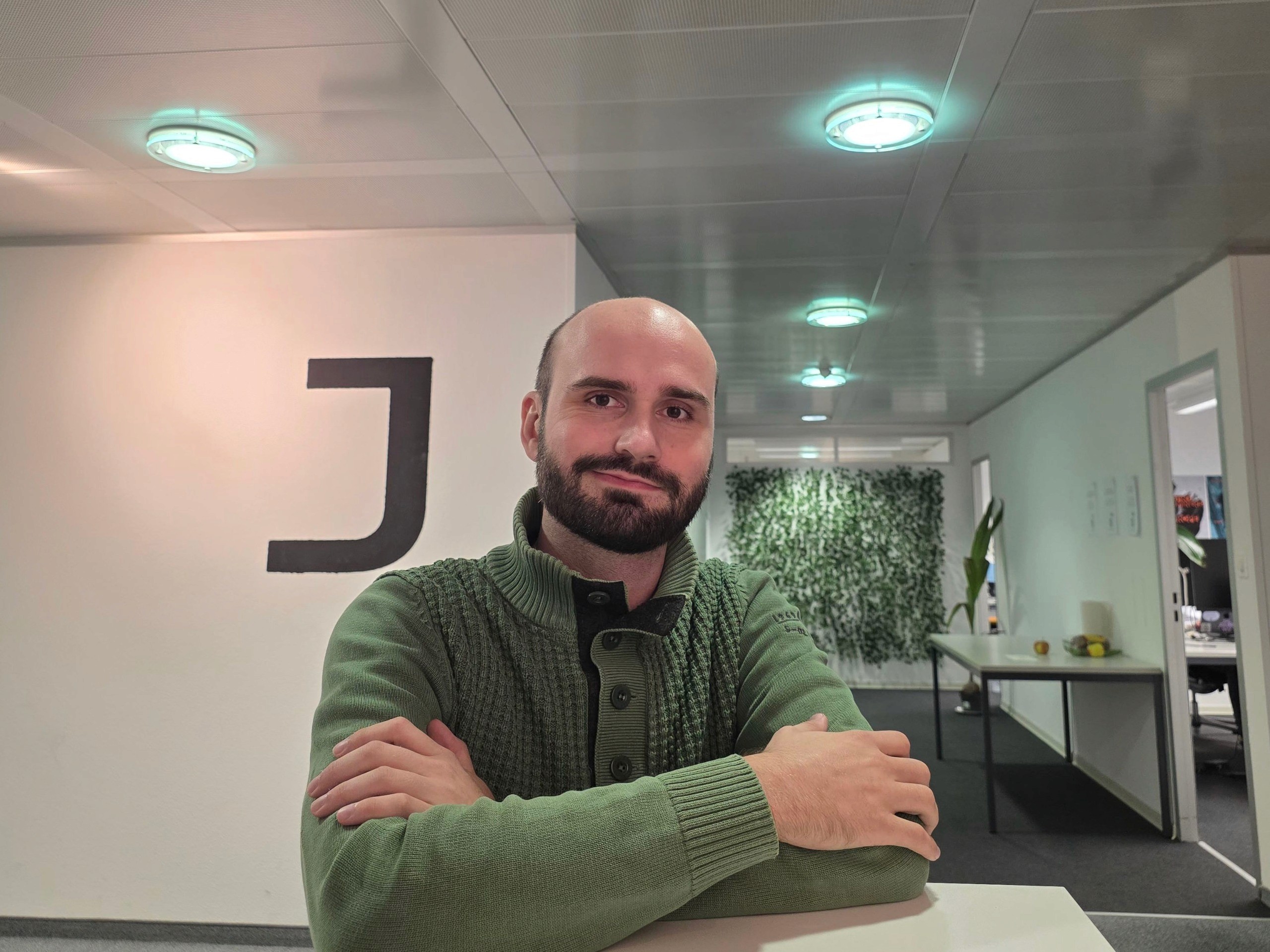
Jan Wiegner is a co-founder of J floor, a nonprofit startup community space in Zurich that grew out of ETH's Student Project House.
The name comes from the J floor of that building, where the most serious startup builders worked side by side from morning to evening. When ETH decided to renovate the space to focus more on student projects, the community was going to scatter. Jan and a group around him raised money for a nonprofit instead and set up J floor as a separate entity.
Getting there took more than 500 calls, asking people for money with no equity in return. Today around 120 people are signed up against 40 desks, and the mix runs from ETH spinouts to people leaving Google, Meta and Nvidia to build their own thing.
Before J floor, Jan studied computer science, computer vision and machine learning at ETH, worked at Oracle, and built two startups. The second, a voice agent platform for SMEs running on real phone lines, was sold to their largest customer. He's now working on his next venture in parallel to organizing J floor.
We sat down to talk about what turns a space into a place that produces companies, how you fundraise when you have no equity to offer, and what Zurich needs next.

Q&A
J floor emerged from of ETH's Student Project House. What did that space actually have that a normal coworking office does not?
The community and culture that emerges when you put smart ambitious people in one space.
It started out as a free makerspace and workspace for students, but when you see the same faces every day working full-time, you strike up a conversation about what they’re building. Some started out with no idea about startups, saw others making their prototypes into products, then raising, and made them think, “I could do that!”.
People raised, went to SF, got accepted to accelerators, some came back for a while. They could give each other intros to VCs and clients, exchange tips on incorporation, scaling up.
The Student Project House today is still a great place to tinker and to start building stuff as a student, but it wasn’t made to be a fulltime workspace for startups. Operating as a separate entity came with many risks, but many more benefits than we even realized at the time. We can organize events with the flexibility of a startup, with VCs, industry, overnight hackathons, or whatever we feel like makes sense for the community.
You made over 500 calls to raise money for something that gives investors no equity back. What actually landed in the end, and what did you learn about how capital moves when there is no return attached to it?
There is a return on investment, but it doesn’t arrive in the way most are used to.
We reached out to VCs first, because we needed to move fast. Many had the excuse that they never did something like this, or that they did not have budget allocation for this type of thing. Some ghosted us after promising to help. That's fine, at the time we were just delusional people claiming we can rally the Zurich ecosystem.
Others made it work despite having the same issues. It took the people that could see our vision of how the Zurich ecosystem could improve. We weren’t asking them to just pay for our office space. Having a space for founders to connect and exchange on a daily basis gives the opportunity for more projects to exist, improve and reach a stage that they become venture backable, while giving the sponsors exposure to them. If you have one day in Zurich it's a single space you can go and chat with all the founders you were planning to meet.
You have around 120 people signed up against around 40 desks, and it works because a large share of the community is in London, SF or China at any given time. What does that tell you about how a startup community actually operates now?
I know it sounds cheesy, but it's all about the people and the connections. Building a startup is a lonely endeavor in many ways. If you can rekindle your ambition because the guy you were sharing a desk with raises a big round, or he introduces you to the right person, that makes all the difference. Even if he now travels around most of the time.
Some people come most days, some every 2 weeks, others spend months in SF or working from a Schenzhen factory. Having a space that you can use as your home base is key. It sounds obvious, but it gives a place to go when you return, to meet people you know, and meet other new cool people.
Zurich has world-class technical talent and a reputation for losing it to San Francisco. What has to change for more of that talent to build here, and what is already changing?
Some businesses make sense to build in SF, let them build there if that’s the case.
But it’s becoming increasingly easier to do the GTM in the US and have the engineering team in Zurich, or just fundraise there. Technical talent in Zurich is cheap compared to SF, not just from ETH but also the big tech offices around. Use that and adapt everything else based on what you’re selling.
SF has the fast capital and the right people that can propel you to startup growth speeds overnight. We don’t need to take the SF formula one to one. Let’s just take the best parts that make the innovation possible and adapt them to Zurich.
On the VC side this means making larger, faster tickets more common, betting on people, not the 5 year business plans that nobody really believes in.
On the founders side, this means being ambitious, high agency and most importantly showing examples of success to other founders. Founding engineers of one company post-IPO becoming the CTOs or angels of the next startups.
Your current lease runs out at the end of the year and you are planning the next three. What does J floor need to become for Zurich, and what would you build if capacity were not a constraint?
In a way it’s out of our control. Most of the value of J floor is provided by great people who attract other great people. We do aim to be a catalyst for the startups that need it, providing resources and connections for crazy ideas and the next innovations. We want to help projects move fast in an environment whose default is to wait and see. A slightly bigger space might be nice, but if we had 10 times more capacity, it wouldn’t be the same and we probably couldn’t meaningfully fill it up.
Startups in Europe are groups of outliers and are all living in small bubbles of fast paced innovation. Different hubs appeared in cities across Europe as bubbles for people to inspire and support each other. J floor can be that bubble that keeps builders in Zurich ambitious, fast, flexible, and kind.
Do stay tuned for what we are planning soon ;)


