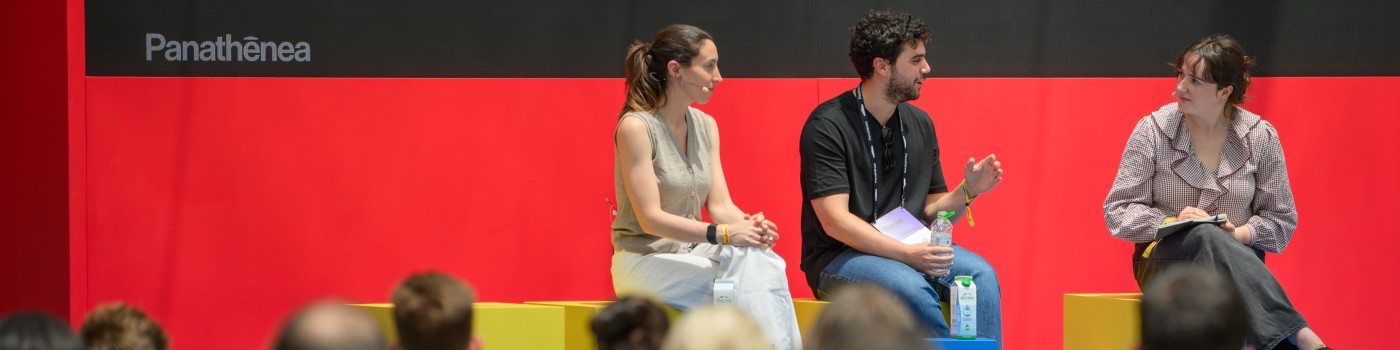
Sejer Hornbæk Dahl Andersen on Why Leaders Use AI and Their Teams Still Don't
Jul 23, 2026
4 min read
Author
Jonas Madsen

Sejer Hornbæk Dahl Andersen is Co-founder and CEO of Murph, a Copenhagen-based AI consultancy that designs, implements, and operates AI-powered workflows for founders and senior leaders who want to bring their own use of AI into the rest of their organization.
Murph is built around a specific starting point: plenty of leaders already use AI daily themselves, but almost none of that individual fluency has turned into systems their teams actually run on. Its work spans industries that are largely not AI-native, from recruiting and executive search to supply chain and logistics, with clients including BlackBerry and Atlas People. And the consulting is only step one: the long-term plan is to turn that industry access into AI-native products built with the experts themselves.
What makes Sejer's perspective interesting is how human-first his approach is, coming from someone who implements AI systems for a living. Murph only automates the work around people's expertise, never the expertise itself, and that stance has become the reason companies trust them: employees stop fearing they're being replaced and start pulling the technology in themselves.
We sat down with Sejer to talk about why traditional, non-AI-native industries are lagging despite leaders' own enthusiasm for AI, where he actually draws the line between what should be automated and what should stay human, what happens to the hours a workflow buys back, the real risk of doing nothing, and his long-term plan for Murph once the gap it's paid to close starts closing on its own.

Q&A
1. Your clients are, almost by definition, the companies that haven't figured this out themselves. What's the honest reason traditional businesses are behind, when half the tools they'd need are sitting free in a browser tab? Is it that nobody's shown them, they don't have the time, it's overwhelming to even know where to start, or is something more structural actually in the way?
All of these reasons are part of the problem, but the biggest one from my point of view is a knowledge gap: the distance between what most leaders think AI is (a glorified search engine you ask questions) and what's actually achievable, which is systems that do real work in your CRM, your inbox, your booking flow. And because AI compounds, that gap widens every month you don't act on it.
The other part is just human. We're all creatures of habit. Peter Thiel writes in Zero to One that a new technology needs to be about ten times better than its closest substitute before people treat it as more than a marginal improvement, and I think the same math applies to changing how a team works. If the current way works fine, nobody moves.
What we've noticed with the clients that do transform is that it starts at the top, but it spreads through the good people. The best employees are never limited by talent, they're limited by hours, and AI rewards exactly the people you want to reward: the better your judgment, the more you get out of it. Good people figure out fast that this makes them exponentially more valuable, and then you get a small revolution inside the business. So the leadership job is really just to open their employees' eyes to what can actually be done with AI. From there, I trust the good people. They'll take the business and implement AI into it like never before.
2. Supply chain, executive search, recruiting: these are relationship businesses, built on trust someone spent years earning. Where's your actual line on what should be handed to AI and what should stay human even if it's slower?
Our whole philosophy at Murph is simple: free people up to do the thing they were actually hired for. Never replace that thing.
What we've seen across almost every role is that people get hired for one thing because they're incredibly talented at exactly that, but they also spend a real part of their time doing something else. That something else is what we work on freeing.
Recruiting is the clearest example I can give, and it's a big part of why we work so much in that industry. In the recruitment companies we've worked with, we saw that a lot of the week actually goes to things like building candidate lists, outreach, scheduling and chasing replies. But that's not where a recruitment company provides its value. The value is in the hiring itself: judging people, reading a candidate in an interview, knowing which person fits which company, making the placement call. That's the skill someone spent years building, and personally I think it stays human. It's also exactly what they should be spending their time on, because it's the part clients are actually paying for.
So the answer to where we draw it: we automate around the expertise, never the expertise itself. Handing what a person is best at to an agent wouldn't create value, it would destroy it. We just want the expert doing expert work for more hours of the week.
3. When you remove five hours a week of manual work from your client, what actually happens to that time? Be honest: does the client reinvest it in higher-value work, or does it quietly show up as a headcount cut at the next budget cycle?
Our tagline at Murph is “Buy time. For the first time.” And the honest caveat to our own tagline is that time itself isn't valuable. What you do with it is.
So we force that decision before we build anything. Every engagement starts with defining the point of saving this process: are we cutting headcount, or are we increasing capacity? Both are legitimate answers, but they're completely different projects, and you have to pick before you start. Spending money on AI only makes sense if there's a return, and you can't measure a return you never defined.
With sales teams, and we've worked with teams at companies like BlackBerry, the answer is almost always capacity. Nobody hires a great closer hoping to fire them once follow-ups are automated. They want the same person in more meetings, working a bigger pipeline. So when we take five hours off a salesperson's week, it's because we agreed upfront that those hours become more meetings, and then we measure whether they actually did. That's the whole game: define success before you build, then check the number.
4. What's the biggest risk a company is actually taking on by not implementing any of this? Not the vague “falling behind,” but the specific way it shows up first: on cost, on speed, on losing people, or something else entirely?
With every major technology, we overestimate the short-term impact and underestimate the long-term impact. Same thing happened in the dot-com era. So the risk of doing nothing isn't visible next quarter, and that's exactly what makes it dangerous.
Where it shows up first, in my mind, is people. Your best employees are the first to realize they could be several times more valuable with proper systems underneath them, and they'll go to the companies that give them that leverage. So the first symptom isn't a cost line. It's your strongest recruiter or closer handing in their notice, and you're left with the people who were comfortable doing things the manual way. You lose from the top.
The second place is competition. When agents can carry a big share of the operational work, the barrier to entry in your industry drops. A three-person shop can suddenly produce the output of a thirty-person one, and they'll price like a three-person shop.
The companies that will win this, though, are not the ones rushing the adoption. They'll treat it as a process that takes years, workflow by workflow, compounding quietly. Slow and steady genuinely wins this race. But slow and steady still means moving. The losing move isn't going slow. It's not starting.
5. How far can you “upgrade” a non-AI native company? Does a traditional company start looking like an AI-native company, or does it just stay a traditional company that's quietly faster? Is there a ceiling on how far this actually takes them before having to rebuild the entire company?
There are two ways of approaching this: either you take an existing process and put AI on top of it, or you redesign the process itself. And I want to be clear that neither is better on its own. It depends entirely on context, and plenty of processes just need AI on top and that's the right call. But in the long run, I believe in redesigning, and there's a book that explains why better than I can.
Edward de Bono argues in I Am Right, You Are Wrong that most of our systems only work well enough, never perfectly, because every system gets built with the technology available at the time. Then the technology improves, and instead of rebuilding, we improve the system a little and stack the next layer on top. Then another layer on top of that. So what companies are actually running today is decades of patches on foundations designed for a completely different toolset. If you rebuilt the same system from scratch with today's technology, it would look nothing like what exists, and it would be dramatically more optimized. But “well enough” is exactly what stops anyone from doing it.
You see this everywhere once you look for it. A recruitment firm's delivery process was designed in a world where every step had to pass through a human: a human reads the CV, a human sends the email, a human updates the system, a human chases the reply. The process isn't built that way because it's optimal. It's built that way because when it was designed, there was no other option. Design the same process today, with agents as a given from day one, and most of those pass-through steps simply don't exist. The human appears where judgment is needed and nowhere else.
So my answer on the ceiling: yes, one exists, but it's self-imposed. A recruiting firm stays a recruiting firm, it doesn't need to start looking like a tech company. The ceiling only shows up if you refuse to ever touch the process underneath. Keep stacking layers on the old foundation and you'll cap out. Rebuild the foundations one process at a time and I honestly don't know where the ceiling is.
6. Zooming out: what's the long-term plan for Murph itself? If the gap you're paid to close is one that eventually closes on its own as the tools get easier to use, what does the business become?
I believe every business should have a Rockefeller plan, a ten-year plan you're actually building toward, and we have ours.
Working with 60+ companies over the past couple of years, what we deliberately try to do is find and work with the industry experts in their niche. That gives us firsthand knowledge of what can actually be done for that industry, the kind you only get by working inside it. And what happens through proving ourselves and our work is that we're often approached by those same clients wanting to partner up: build products together that can take over their respective market. They bring decades of domain knowledge and the network to sell into. We bring the ability to actually ship AI-native products. That's where I want to get.
So long term, the way I see it, Murph becomes something like a product studio for traditional industries. The consulting arm keeps finding the real problems, funding the learning, and putting us next to the right experts, and the products compound on top of it. We're already doing this in a couple of industries now, partnering with some of the biggest players in their space.
So if the gap we're paid to close eventually closes on its own, that's fine. The consulting was never the endgame. It's the engine that finds the products.