UK & EU relationship up for discussion?
May 8, 2025
2 min read
Author
By Lucas Ohrt, Senior Analyst @ BlackWood
Europe is losing ground fast. Since 2000, productivity growth has lagged 30 percent behind the U.S. The same trend holds for venture capital (VC). Over the past decade, the European Union (EU) has averaged just 0.3 percent of GDP in VC funding, less than one-third of American levels. Beneath these numbers lies a structural failure I've witnessed up close: Europe's inability to transform promising startups into category-defining leaders.
As the U.K. strikes a trade deal with the U.S. this week and the May 19 U.K.-EU summit approaches, Brussels continues to signal hesitation: even a modest British request for mutual recognition of product certifications—a technical step that would ease trade and reduce friction—was recently rejected by key EU member states, including France. If we can't align on something as basic as product standards, we shouldn't harbor an illusion that a deeper economic partnership is within reach.
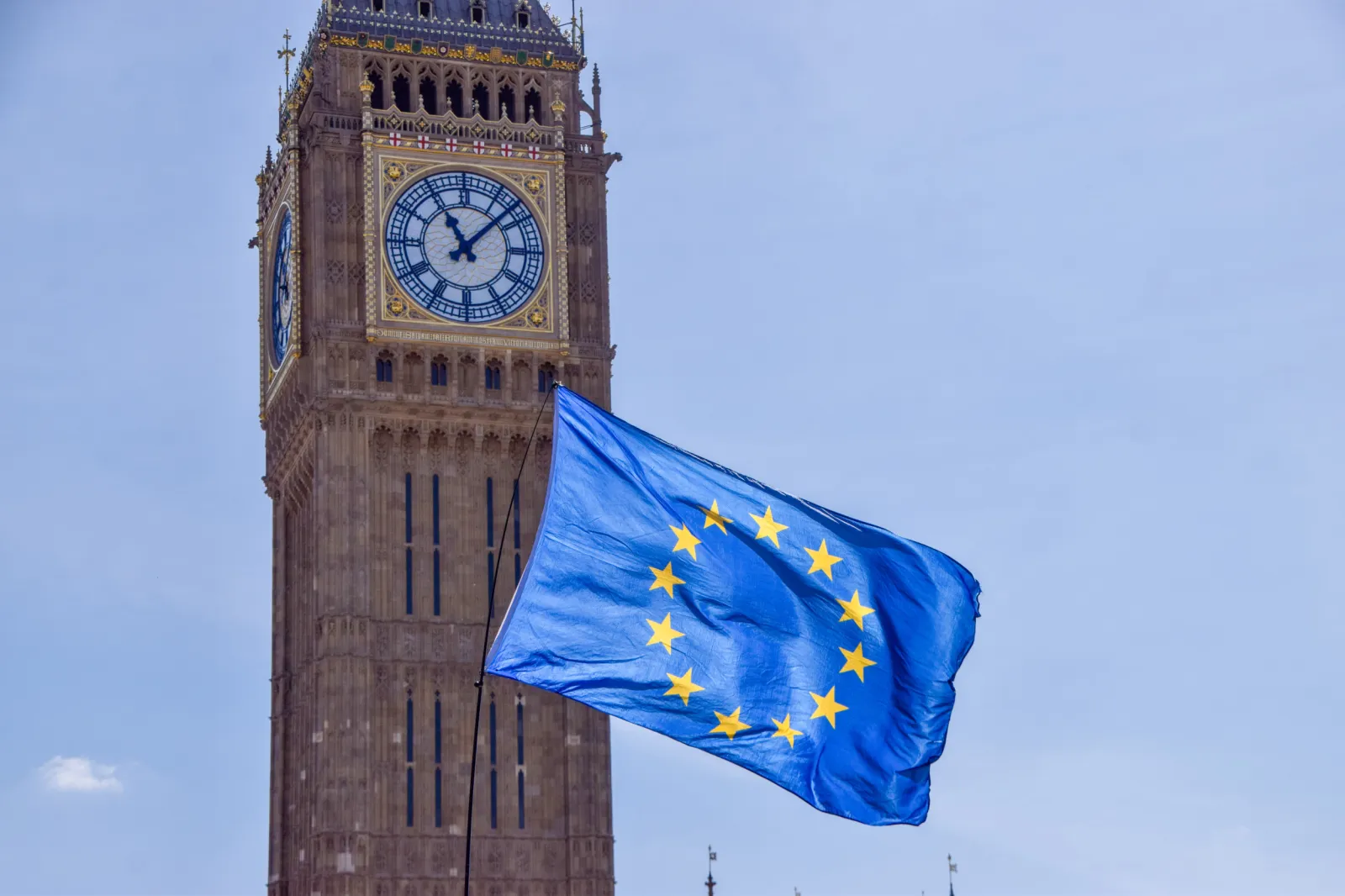
The flag of the European Union flies next to Big Ben. | Getty Images/Getty Images
U.K. Prime Minister Keir Starmer played the royal card well, tiptoeing around President Donald Trump and securing a symbolic win. However, with Trump, one thing is certain: stability is borrowed time. Tariffs will be back. The U.K. brings deep capital markets and a world-class startup ecosystem. The EU brings a strong industrial manufacturing base and a massive market. Together, both could create an economic powerhouse if only Europe would finally address its chronic aversion to risk and investment.
The problem runs deep, and it's not just about regulation, but about where Europe's money actually goes. According to the IMF, Europeans invest just $1 in equities, funds, and pension schemes for every $4.60 Americans put into equivalent asset classes. That figure alone reveals a structural failure in Europe's ability and willingness to support risk-taking capital.
Under the EU's Solvency II directive, European pension funds and insurers were granted more flexibility, but at the cost of intense scrutiny under the prudent person principle. All investments, particularly in non-traditional assets like venture capital, must be fully documented, justified, and continuously monitored. In theory, this ensures responsibility. In practice, it breeds a culture of caution.
As Jimmy Nielsen, founder of European-based Heartcore Capital, recently pointed out, a pension fund faces nearly the same regulatory burden whether it invests €20 million in a VC fund or €150 million in infrastructure. The result? Small, high-risk investments are too expensive and administratively burdensome to justify and thus are ignored, not because they're unworthy, but because the system makes them unattractive.
Thus, a new approach is needed. An Economic NATO, with three principles highlighted below, should focus on pragmatic coordination, not political integration, and crucially, it must include the U.K.