Casey & the $500B commercial insurance market
Jan 30, 2026
2 min read
Author
Rasmus Holt & Oliver Preisler
Commercial insurance is a $500B market, yet a lot of the work still moves through email threads, PDFs, and portals.
That is the gap Casey is going after. The product is built for the messy, high-value end of the market.
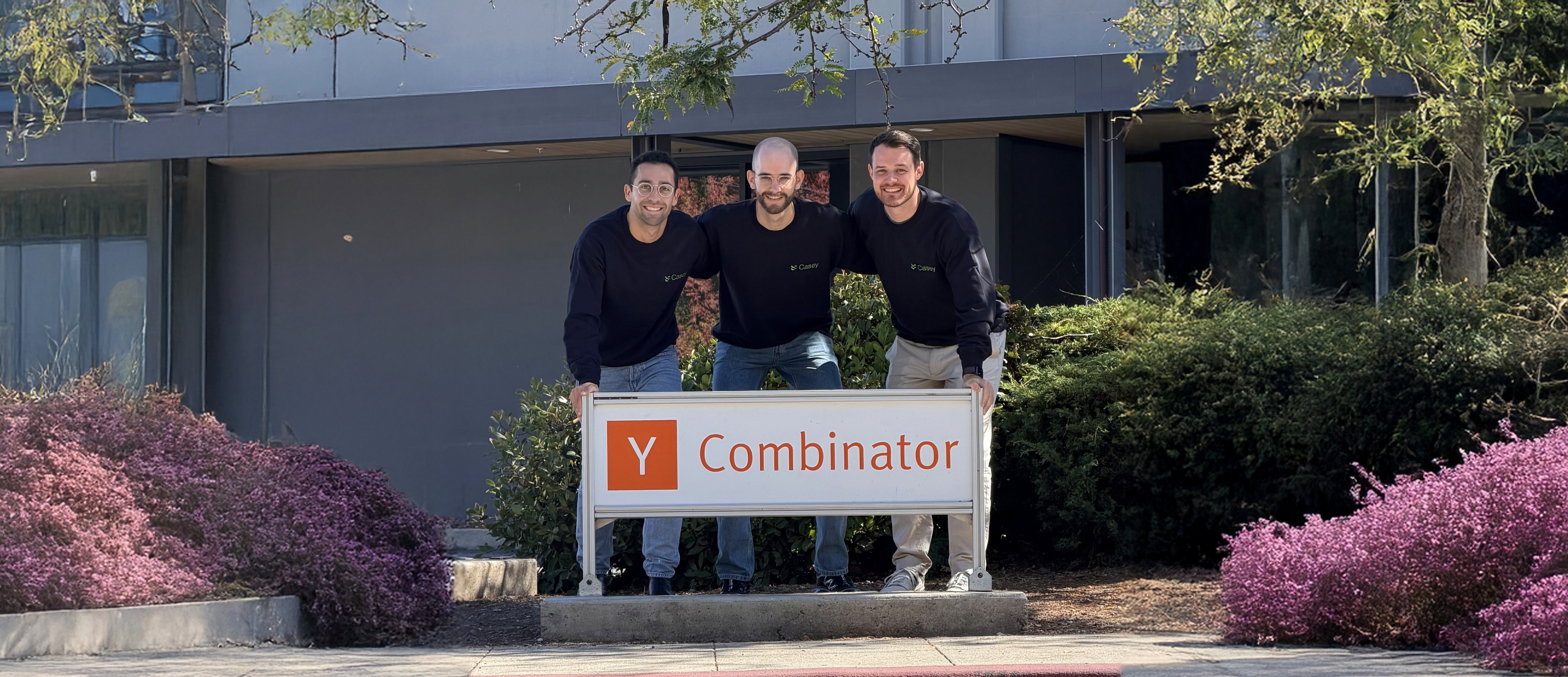
Maximilian co-founded Casey in San Francisco with Pascal Küng and Nico Hänggi. The team were first employees at Grape and saw the inefficiency up close. They decided to rebuild it.
Casey’s first wedge is simple and sharp. They automate the submission process for commercial brokers. From filling out carrier portals to handling email-based submissions for complex risks. The platform ingests any document type, often hundreds of pages at a time, automatically builds out the exposure, loss history, and program structure, and populates required submission forms in seconds.
Early December, the team presented at Y Combinator Demo Day. The interesting part since then is the initial demand. Casey started with US commercial brokers in mind, but inbound is coming from Australia and Europe - plus MGAs, reinsurance brokers, and Lloyd's-adjacent players asking if they can use it too.
We sat down with Maximilian to talk GTM, why submission workflows are still the chokepoint, and what it takes to turn “email and PDFs” into software that actually moves the market.
Q&A - Maximilian @ Casey (YC F25)
Q: Where exactly does “submission” break today, step by step?
A broker gets a new client. They collect documents, loss runs, schedules, prior policies, financials, often hundreds of pages across dozens of PDFs and emails. Then the manual work starts.
They re-key the same data into their AMS.(red. Agency Management System) Then re-key it again into ACORD forms. Then sometimes re-key it again into each carrier's portal, and every carrier has a different portal with different fields. For a single complex risk, a broker might enter the same address, the same loss history, the same coverage limits multiple times across PDFs and portals, taking days to prepare.
Q: What is the atomic unit of value Casey delivers, and how do you prove it in hard numbers?
Time back. A professional indemnity submission that took +10 hours now takes minutes with Casey.
We measure it directly: time-to-submission before and after. For one brokerage, their average submission prep dropped from +10 hours to 14 minutes.
The second metric is accuracy. Manual re-keying, or outsourcing parts of the process has an approx. 6-8% error rate. Errors mean back-and-forth with underwriters, delayed quotes, sometimes lost deals. For carrier portals, our accuracy is 99%, when preparing email based submissions our threshold is 95%, and anything below our confidence thresholds gets flagged for human review.
Q: You are enriching risk profiles with sources like telematics. How do you avoid “garbage in, confident out”?
Regarding telematics, we work with public sources that our brokers already use, but will research manually. We show exactly where each piece of information comes from, both for telematics, or when we extract data from client documents. If we pull a figure from page 47 of a PDF, the broker can click through and verify the source.
Q: What is your distribution wedge inside broker workflows?
The wedge is painful. No one likes to copy-paste data across forms, portals and internal systems. With Casey, a broker can upload client information today and start automatically filling out literally any form they need for submitting to markets.
Q: How do you build defensibility in a world where workflow tools get copied fast?
You need to build infrastructure to make sure your agents function like intended. Those who have tried to drop 30+ documents into ChatGPT and asked it to extract data, know it breaks. With every submission, we build up our set of evals, and build up defensibility. The same goes for web agents, there our defensibility is Nico. There’s genuinely no one more qualified in the insurance industry to tackle carrier portal filling, than him.
Q: You expected the US first, but initial inbound is global. What changes across other markets?
What we've learned is the core extraction and automation layer is pretty geography-agnostic. A PDF is a PDF. The localization is at the output layer, which forms we populate, which portals we serve, etc.
So expansion isn't rebuilding for each market, but it’s essentially just understanding and learning about the nuances of the local forms and portals. Once you’ve built out the right technical foundation, you can expand pretty quickly.
Again, it’s still early days and we haven’t figured it all out yet, but Casey will be the fastest and most flexible way for brokers to submit to markets.
-


