What Exactly Goes Public in an AI IPO?
Apr 3, 2026
4 min read
Author
Maxime Pasquier
Lately, I have been reading about OpenAI and the increasingly less hypothetical possibility of an IPO.
There comes a stage in the life of certain technology companies when they stop being discussed like companies and start being discussed like natural phenomena. The product works, the valuation acquires a faintly theatrical quality, the company becomes too large and too strategically relevant to be spoken about in ordinary proportions, and “eventual listing” begins to circulate with the calm assurance of people who will not personally have to read the S-1.
OpenAI feels somewhere around there now.
Not because it has filed to go public. It has not, at least yet. But it increasingly looks like a company being arranged for the scale, scrutiny and capital appetite that public markets are designed to absorb. It has reorganised itself around a Public Benefit Corporation under nonprofit control, announced a fresh financing round of $122 billion at an $852 billion post-money valuation, and according to the Wall Street Journal, has held informal talks with banks about a possible IPO.
What reading all this got me thinking about, though, was something slightly more interesting than the usual “when does it list?” speculation: what exactly would public investors be buying if OpenAI ever did?
Because private and public markets do not really buy the same thing. Private markets can still underwrite promise. They can pay for vision, optionality, founder mythology and the pleasant sensation of getting in early on something “structurally important”. Public markets are usually less sentimental. Sooner or later, they ask the dull, brutal question beneath every glamorous growth story: yes, but what here actually lasts? And when that question is answered badly, they are not known for their patience.
With AI businesses, that is a more awkward question than people sometimes admit.
For the past two years, the industry has mostly been discussed through the language of intelligence: better models, better reasoning, better agents, better benchmarks. Fair enough! But markets do not always reward what is most intellectually impressive, as more than often, they tend to reward whatever becomes hardest to dislodge.
If that sounds slightly abstract, Anthropic recently provided a useful illustration.
In the span of a few days, coverage ranged from “Anthropic Races to Contain Leak of Code Behind Claude AI Agent” to “Anthropic leaked 500,000 lines of its own source code.” Anthropic said the leak came from human error during a software update, not a breach, and that no model weights, customer data or credentials were exposed. Still, more than half a million lines tied to Claude Code were enough for developers to inspect unreleased features and reconstruct parts of the product in public. One imagines this was not the preferred product launch sequence…
That does not mean Anthropic has no moat. It does, however, remind us that some of what looks magical from the outside can begin to look a lot more like software once exposed. Not ordinary software in the sense of trivial, clearly not, but ordinary in the sense that it becomes legible: something built by people, understandable by other people, and in certain places reproducible by sufficiently motivated people.
Which brings me back to OpenAI. If OpenAI ever does go public, I doubt the central question will be whether it has the smartest model. Smart models matter enormously, of course, but they rarely remain a permanent fact. Competitors catch up, product advantages narrow, and what looks distinctive in one cycle has a habit of appearing far less singular in the next. From a markets perspective, the deeper question is whether OpenAI has built something more durable around the model, a position in the ecosystem that becomes difficult to route around.
As once a company is embedded deeply enough in enterprise workflows, procurement habits, cloud relationships, regulatory conversations and government contracts, the investment case changes. At that point, investors are no longer just underwriting technical excellence. They are underwriting default status, with the possibility that enough businesses, institutions and developers begin organising around one system that replacing it starts to feel less like switching software and more like reopening a settled question that most people would prefer remained settled.
Technology history is full of examples where invention created the excitement while infrastructure, distribution and default status captured most of the economics. AI may not be any different. The first company to make something extraordinary is not always the one that captures the deepest long-term premium. Quite often, it is the company that turns itself into the layer others end up building on, integrating with, or simply assuming will be there.
From the outside, OpenAI increasingly looks as though it understands this perfectly well. Its recent evolution makes it look less like a remarkable lab and more like a company preparing to be valued as a strategic layer: part software provider, part platform, part institutional utility. Which, to be fair, is exactly what one would do if one wanted public markets to treat the business less like a brilliant product cycle and more like infrastructure….
So what exactly goes public in an AI IPO? What goes public is the claim that this particular company has managed to turn frontier research, enormous capital requirements, political scrutiny and relentless competition into something durable enough for ordinary shareholders to own.
Public markets do not pay top dollar for brilliance alone, they pay for whatever has already become difficult to escape.
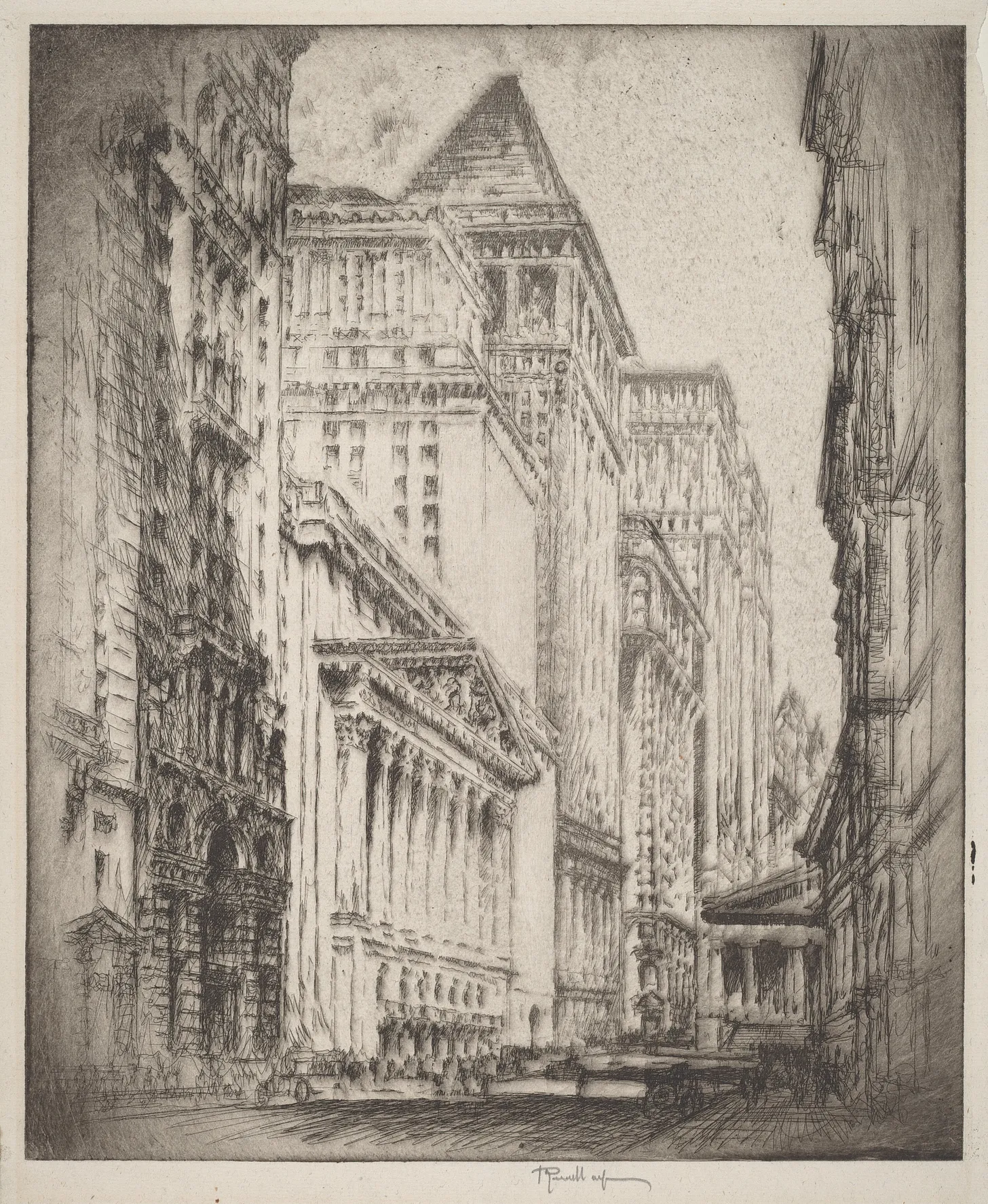
Painting: Joseph Pennell’s “New York Stock Exchange” (1923)
Sources
Axios: Anthropic leaked 500,000 lines of its own source code
Business Insider: A 4 a.m. scramble turned Anthropic’s leak into a ‘workflow revelation’
OpenAI: OpenAI raises $122 billion to accelerate the next phase of AI
The Wall Street Journal: OpenAI Plans Fourth-Quarter IPO in Race to Beat Anthropic to Market
The Wall Street Journal: Anthropic Races to Contain Leak of Code Behind Claude AI Agent