Onstage: Building a Pan-European Demo Day
Jan 9, 2026
3 min read
Author
Intro by Jonas Madsen, Head of IR @ Blackwood

Issie James is the co-founder of Onstage, a fast-growing venture platform often dubbed “the YC of Europe.”
In less than two years, Onstage has become one of Europe’s most active launchpads for early-stage founders, connecting the top 1% of startups with thousands of investors across the continent.
Each Onstage Demo Day now draws more than 200 investors in-person and over 1,000 livestream viewers, with alumni raising more than £480 million from top-tier VCs.
Before co-founding Onstage, Issie helped build founder communities at Embarc (backed by Notion Capital, later acquired by OPUS) and led strategic operations across startups from London to the Caribbean.
Today, she’s focused on turning Onstage into Europe’s most effective venture gateway, where investors discover the continent’s best founders before anyone else.
Naturally, we were intrigued, so a few questions felt appropriate.
Q&A - Issie James, Co-founder @ Onstage
What gap did you see in the European ecosystem that made you build Onstage? How is it different from traditional accelerators or demo days?
Europe has plenty of accelerators and incubators, but most are tied to a single organisation or small group of investors. There was no platform that brought together a large, pan-European investor base, the ecosystem was (and still is) highly fragmented.
That fragmentation makes fundraising a painful process for founders. It’s essentially a full-time job to reach and impress the right investors.
Onstage solves this by letting founders reach hundreds of investors through a single 10-minute application. Those who make it into the Top 100 or the final gain additional credibility, often receiving 20–30 investor inbounds as a result.
It helps founders create the FOMO needed to accelerate their rounds so they can get back to building faster.
We also differ from traditional accelerators because we take no equity and require no ongoing time commitment - founders simply plug into our Demo Day when they’re ready to raise.
With 200+ investors in the room and thousands online, how do you balance access with curation, ensuring founders meet the right investors, not just more investors?
We’ve flipped the traditional dynamic. In most fundraising processes, founders are forced to guess which VCs fit their stage, sector, or geography. That inefficiency wastes time for both sides.
At Onstage, we give investors full access to the applicant pool. They can filter by thesis and reach out directly to the founders that match. We then facilitate introductions on both sides, equating to 2,000 curated connections per Demo Day.
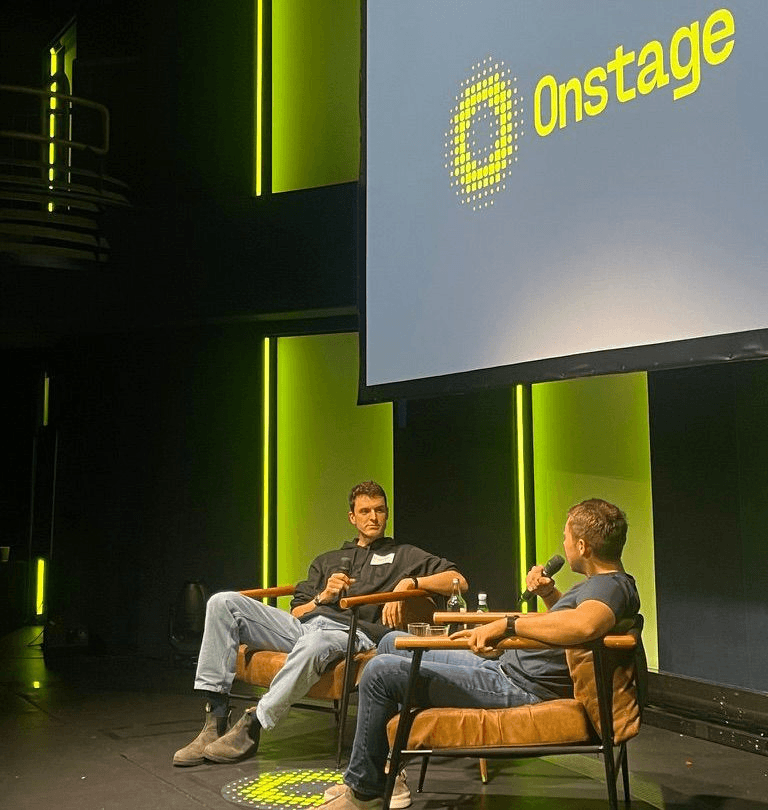
VC Media Mogul H. Stebbings & Hector Mason @ Demo Day - 23rd October 2025 in Soho, London.
Q&A Continued …
What does “the YC of Europe” really mean to you? Is it about scale, outcomes, or ecosystem impact?
For us, it’s about ecosystem impact.
We’re not trying to replicate YC’s model - we’re adapting the essence of it to Europe’s structure. YC brings top early-stage founders into one concentrated space, in front of a concentrated group of investors, over a concentrated period of time, enabling them to close rounds fast.
Europe, by contrast, is spread across multiple hubs with no single focal point. Our goal is to bring the continent’s best founders and investors together at key moments, creating the same kind of concentrated fundraising energy that YC does for Silicon Valley.
You’ve built communities before. What key lessons did you take from Embarc and Bocobay that shaped how you lead Onstage today?
The hardest part of building a community isn’t running it day-to-day, it’s attracting the right people from the start.
Embarc taught me the power of scarcity to drive demand and perceived quality. We used an application process for every event and only accepted around 25% of applicants. It was an effective hack: it positioned us as a high-quality community while keeping conversion rates strong for attendees.
I brought a lot of those principles into the early days of Onstage, using selective access and clear positioning to build quality quickly. Of course, the model has evolved a lot since then, but that early mindset helped shape how we approach curation and growth today.